Most pages selling a real estate mentorship program describe the outcome (financial freedom, passive income, building wealth) and skip the part people actually want to know: what happens after you sign up. What does week one look like? Week six? Is it a weekly call, a group chat, a pile of videos you’re supposed to get through on your own?
The honest answer is that it varies a lot between programs, and a lot of the marketing hides that variation. Here’s a realistic shape of it, based on how a working mentorship program is actually structured, not the highlight reel.
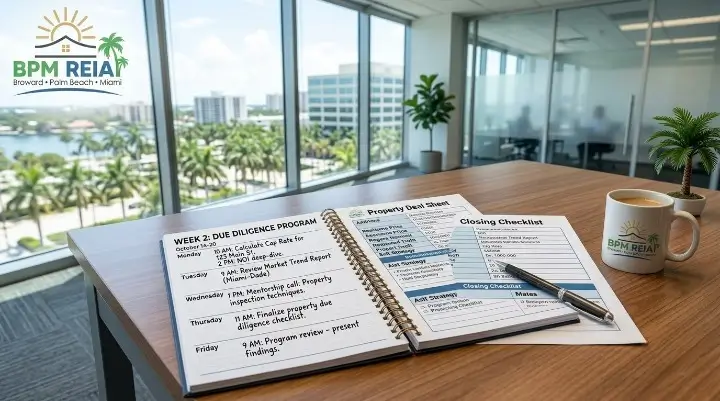
Week One: Assessment, Not Instruction
The first week usually isn’t teaching anything yet. It’s figuring out where you actually are: your capital, your credit situation, how much time you can realistically commit, and what you’re trying to get out of investing in the first place (income now, long-term equity, a full-time exit from your current job).
This step gets skipped in bad programs, and it shows later. If a "mentorship program" jumps straight into content on day one without asking anything about your specific situation, that’s a program built for volume, not for you individually.
Weeks Two to Four: Strategy and Market Orientation
Once your starting point is clear, this stretch is usually about narrowing down a strategy: wholesaling, fix-and-flip, buy-and-hold rentals, short-term rentals, or something more specialized like sale-leasebacks. Each one has a completely different risk profile, timeline, and capital requirement, and a decent mentorship program won’t push you toward whichever one is easiest to teach in a video course.
This is also when you start getting introduced to the local market specifics that actually matter: financing options for investment property (which look different from a standard mortgage), typical rehab costs in your target area, and which neighborhoods fit which strategy.
Weeks Four to Eight: Deal Analysis, Repeatedly
This is where most of the real learning happens, and it’s also the part that’s hardest to fake in marketing material, because it’s repetitive by design. You bring properties. You run the numbers. Your mentor tells you what’s off. You do it again.
Nobody gets good at underwriting a deal by watching someone else do it once. It takes reps, on real listings, with real feedback, until the math starts to feel automatic instead of intimidating. A program that skips straight to "here’s how to find deals" without this stage is setting people up to overpay for their first purchase.
Weeks Eight and Beyond: Live Deals and Accountability
By this stage, a working mentorship program stops looking like a course and starts looking like ongoing coaching: reviewing actual offers before you submit them, walking through inspection reports, prepping for a negotiation, or troubleshooting a financing hiccup. The cadence tends to shift from scheduled lessons to on-demand support tied to whatever’s actually happening in your deal pipeline.
This is also usually when group events and in-person meetups start to matter more. Learning alongside other investors going through the same stage, at real estate coaching events, tends to surface questions you wouldn’t have thought to ask on your own.
| Phase | Main Focus |
|---|---|
| Week 1 | Assessment, not instruction |
| Weeks 2-4 | Strategy and market orientation |
| Weeks 4-8 | Deal analysis, repeatedly |
| Week 8 and beyond | Live deals and ongoing accountability |
What Doesn’t Show Up on a Weekly Schedule
Not everything fits neatly into a week-by-week structure, and it’s worth naming what doesn’t:
- Vendor and lender relationships build over the whole program, not on a set timeline. You’ll get introduced to contractors, title companies, and lenders as it becomes relevant, not all at once in week two.
- Confidence doesn’t follow a schedule either. Some people feel ready to make an offer by week six. Others need three or four months of deal review before they trust their own numbers. Both are normal.
- Deal flow is outside anyone’s control. A mentor can teach you how to evaluate a property fast. They can’t guarantee the right one shows up on your timeline.
How This Compares to Just Buying a Course
A lot of people confuse a mentorship program with a self-paced course because both get marketed with similar language. They’re not the same thing. If you’re trying to figure out which fits your situation, it’s worth reading mentored training versus self-paced courses, especially if flipping is your intended strategy, since the gap between the two matters more there than almost anywhere else.
What This Looks Like at BPM REIA
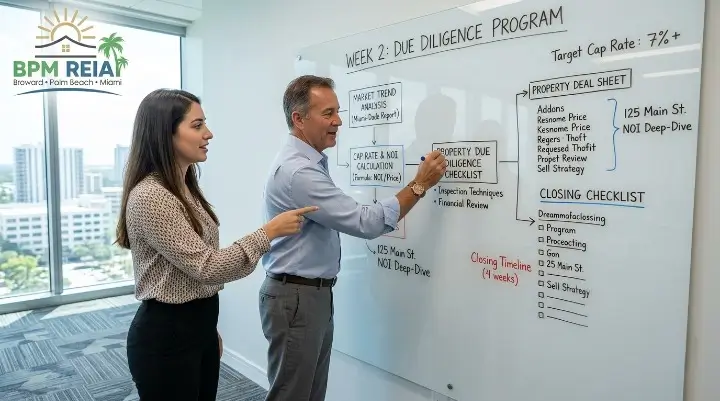
BPM REIA’s program follows this same general arc, adjusted for the Broward, Palm Beach, and Miami markets specifically. Since it’s led within a National REIA network with 25+ years and $250M+ in transactions behind it, the deal review stage draws on patterns seen across a large number of investors, not just one mentor’s personal experience.
If you want to know exactly what your own first weeks would look like based on your starting point, that’s a better conversation than another blog post. Book a discovery call and we’ll walk through it directly, including whether a mentorship program is even the right fit for where you’re at right now.
Real estate mentorship programs work best when the structure matches the person, not the other way around. If you go into one expecting a rigid syllabus, you’ll be surprised by how much of it responds to what’s actually happening in your deals. That’s not a flaw. That’s the entire point of having a mentor instead of a textbook.
Find Out What Your First Weeks Would Look Like
Every starting point is different. Talk to BPM REIA about yours before you commit to a program.



One Response