100% deal funding means an investor can cover a qualified deal’s purchase and repair costs without putting up their own cash – the capital comes from a lender, a private money partner, or a mentor network, based on the deal’s numbers rather than the investor’s bank balance. It’s not free money, and it’s not available on every deal. It’s available on deals that meet an underwriter’s or partner’s criteria, and understanding those criteria is most of what separates investors who get funded from investors who keep getting told no.
If you’ve spent any time in Florida real estate investing groups, you’ve heard the phrase “100% funding” thrown around a lot – usually without much explanation of what it actually takes to get there. We hear the same question on almost every Discovery Call: I found a deal. Now what? For a lot of new investors, the deal was never the hard part. Getting someone to fund it was.
This guide breaks down the real funding strategies Florida investors use, what actually makes a deal fundable, and where mentorship fits into the process – because a mentor’s job here isn’t just moral support. It’s the person who tells you, before you go to a lender, whether your numbers will survive contact with reality.
What “100% Deal Funding” Actually Means (and What It Doesn’t)
100% funding covers the deal’s capital needs – purchase price and often rehab costs – when the deal itself qualifies. What it doesn’t cover is you. Holding costs, insurance, permit fees, and reserves for the unexpected still come out of your pocket, and any investor who tells you otherwise hasn’t closed enough deals to know better.
The distinction matters because it changes what you should actually be asking a funding source. The real question isn’t “will you give me 100%?” It’s “what does this specific deal need to look like for you to say yes?” Lenders and private money partners fund numbers, not intentions. A deal with a clean exit strategy and accurate comps gets funded. A deal built on optimistic guesses doesn’t, no matter how much money the fund has sitting around.
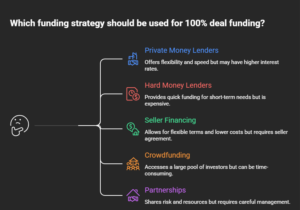
The Main Deal Funding Strategies Florida Investors Use
There isn’t one path to getting a deal funded. Most active investors end up using a mix of these, depending on the deal type and how fast they need to move.
Private Money Partners
Private money comes from individuals – not institutions – who lend based on relationship and deal quality rather than a standardized underwriting process. Terms vary more than with a bank or hard money lender, which cuts both ways: a strong private money relationship can move faster and flex more, but it also depends entirely on trust you’ve built over time. This is usually where a mentor’s existing network matters most, since walking in cold to a private lender with no track record is a much harder pitch than being introduced by someone who’s already vouched for you.
Hard Money Lenders
Hard money loans are short-term, asset-based loans where the property itself – not your income or credit score – is the primary security for the loan. They’re built for speed and for deals a conventional lender wouldn’t touch, which is exactly why flippers and wholesalers lean on them. The tradeoff is cost: rates and points run well above a conventional mortgage, so the math only works if your timeline and margin can absorb it. Hard money is the right tool for a deal that needs to close in two weeks, not the right tool for a buy-and-hold you plan to sit on for ten years.
Creative and Seller Financing
Creative financing covers a range of structures – seller financing, subject-to, lease options – where the seller effectively takes on part of the lender’s role. It shows up most often on deals where the seller has equity, wants a faster sale than the retail market offers, or has a reason (tax, timing, condition of the property) to prefer a non-traditional close. It requires more negotiation skill than writing a check, and it’s a strategy most new investors underuse simply because nobody walked them through how to structure the conversation.
100% Funding Through a Mentor Network
This is where BPM REIA’s model differs from a lot of what’s out there. Instead of sending you off to figure out financing on your own after teaching you deal analysis, funding is built into the mentorship relationship. A mentor reviews the deal, helps you package it correctly, and connects you to the private lending network that already trusts the program’s underwriting standards – because that network has seen how BPM REIA vets deals before they ever reach a lender’s desk.
What Makes a Deal “Fundable” in South Florida
Fundability comes down to a handful of things every lender and private money partner is checking, whether or not they say it out loud:
- Accurate comps and ARV. ARV (after-repair value) is what the property will be worth once the work is done. Overestimate it, and the deal looks better on paper than it will in reality — which is exactly what a lender’s own appraisal is designed to catch.
- A realistic repair budget, not a number pulled from a contractor’s rough guess over the phone.
- A clear exit strategy — sell, refinance and hold, or wholesale — because a funder wants to know how they get repaid, not just that the property has equity.
- Margin that survives South Florida’s actual costs. Insurance, permitting timelines, and labor and material costs in Broward, Palm Beach, and Miami-Dade counties run differently than they do in the markets a lot of national YouTube content is filmed in. A deal that pencils out in a generic spreadsheet doesn’t always pencil out here.
How BPM REIA’s 100% Funding Program Works
Funding isn’t automatic just because you’re a member – it’s available on qualified deals that meet BPM REIA’s underwriting criteria, and a mentor reviews every deal before it moves forward. In practice, that means bringing a mentor into the process early: before you’re under contract, not after, when there’s still room to adjust the numbers or walk away from a deal that doesn’t hold up.
Once a deal is reviewed and makes sense, the mentor helps package it – comps, repair scope, exit plan – in the format a lender or private money partner actually wants to see, then connects you into the funding network. That packaging step is where a lot of deals get funded or don’t, and it’s the part most self-taught investors skip entirely.
Common Funding Mistakes New Investors Make
We see the same handful of mistakes come through on Discovery Calls, almost on repeat:
- Chasing the deal before confirming the financing picture. Getting excited about a property, then trying to reverse-engineer funding after you’re already emotionally attached, puts you in a weak negotiating position.
- Using soft comps. Pulling numbers from a Zillow estimate instead of recent, comparable, closed sales is the fastest way to get a deal rejected — or worse, funded on bad numbers.
- Ignoring holding costs. Insurance in South Florida isn’t what it was five years ago. A repair budget that doesn’t account for it is incomplete.
- Skipping the mentor review to save time. It rarely saves time. It usually means finding out a deal doesn’t work after you’ve already made an offer, instead of before.
- Assuming “100% funding” means no due diligence. Funders — including a mentor network — still vet the deal. The number in the marketing is the ceiling, not a guarantee.
How to Get Your First Deal Funded: Step by Step
- Get your financing picture straight before you start looking. Know what kind of funding you’re aiming for so you’re not scrambling once you find a property.
- Find the deal and pull real comps — recent, nearby, comparable condition — not estimates.
- Bring it to a mentor for review before you make an offer, so the numbers get stress-tested while there’s still time to adjust.
- Package the deal: purchase price, ARV, repair scope, and exit strategy, in a format a lender or private partner can act on quickly.
- Submit to funding through the private lending network or hard money lender your mentor has already vetted.
- Close, and start building the track record that makes your second deal easier to fund than your first.
That last point matters more than it sounds like it should. Every deal you close and repay makes the next conversation with a private lender shorter, because you’re no longer an unknown.



One Response