Plenty of successful investors never had a coach. That’s true, and it’s worth saying up front, because most of the content on this topic pretends otherwise. People learn to invest solo all the time. The real question isn’t whether it’s possible. It’s what that first year tends to look like each way, and whether the difference is worth the cost of coaching for your specific situation.
This is really the core question behind real estate investing coaching: not whether it works, but what it changes. We’ll walk through both paths as honestly as we can.
Month One to Three: Getting Oriented
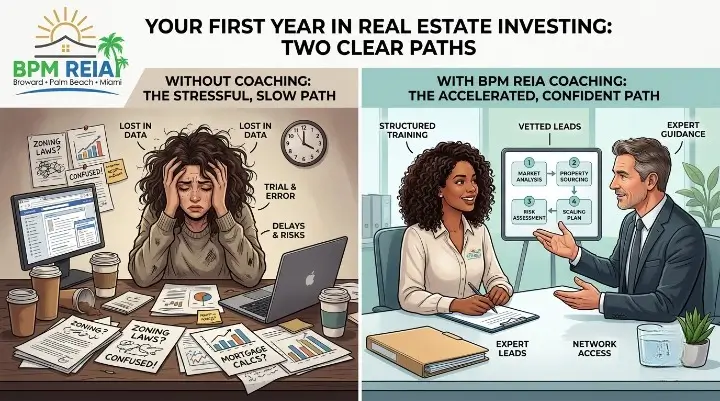
Going it alone, most new investors spend the first few months consuming content. Podcasts, YouTube, maybe a book or two. This isn’t wasted time, but it’s slow, and it’s unfiltered. You don’t yet have the experience to know which advice applies to your market and which is aimed at a completely different one (a lot of real estate content is produced for the Midwest, where price points and financing look nothing like South Florida).
With coaching, those first months get spent differently: figuring out which strategy actually fits your capital, your time, and your risk tolerance, and getting a realistic read on what your specific market allows. You still do reading and research. It’s just aimed, instead of scattered.
Month Three to Six: The First Real Deal Hunt
This is where the paths diverge the most.
Solo investors in this stage typically make one of two mistakes: they freeze up and keep "researching" past the point of diminishing returns, or they move too fast on the first deal that looks decent because they don’t have a way to sanity-check it. Both are understandable. Neither one is cheap.
With coaching, you’re bringing actual deals to actual review before you commit. That doesn’t mean every deal gets approved. It means the bad ones get caught before closing instead of after, when the "surprise" foundation issue is now legally yours.
Month Six to Twelve: Handling the First Problem
Every investor’s first year includes at least one moment where something goes sideways. A tenant issue, a contractor who disappears mid-job, a permit delay, an insurance renewal that comes in triple the previous quote (this one is especially common in South Florida right now).
Going it alone, you’re troubleshooting that from scratch, usually at 9pm with a search engine. It gets resolved eventually. It just costs more time and often more money than it needed to.
With a coaching network behind you, the honest version is: you’ve usually seen someone else go through the same problem already, or you know who to call. The panic gets replaced by a phone call.
| Stage | Going It Alone | With Coaching |
|---|---|---|
| Months 1-3 | Scattered, unfiltered content | Research aimed at your market and goals |
| Months 3-6 | Freeze up, or move too fast on a deal | Deals reviewed before you commit |
| Months 6-12 | Troubleshoot problems from scratch | Call someone who’s seen it before |
| Cost | Your time only | Program fee, in exchange for a faster feedback loop |
What the Cost Difference Actually Buys
Let’s not dodge the obvious point: coaching costs money, and going solo doesn’t (beyond your own time). So what does that cost actually buy?
It’s not buying certainty. Nothing does. It’s buying a shorter distance between "I made a mistake" and "someone caught it." In real estate, that distance is often measured in thousands of dollars, because mistakes tend to surface after money has already changed hands, not before.
If you have more time than capital right now, going it alone for a while and building knowledge slowly is a completely rational choice. If you have capital you can’t afford to lose on an avoidable rookie error, or you’re trying to move faster than trial and error allows, that’s when coaching tends to pay for itself.
What We See in South Florida Specifically

BPM REIA works with investors across Broward, Palm Beach, and Miami, and the same pattern shows up constantly: the investors who struggle most in year one aren’t the ones who lack ambition. They’re the ones making decisions without anyone local to check their assumptions against. National content doesn’t know that your flood insurance quote just doubled, or that a specific municipality has slowed permitting to a crawl this quarter. Local coaching does.
If you’re weighing this decision and want the fuller picture of what coaching includes, we’ve broken it down in what real estate investing coaching actually covers, and what it doesn’t.
And if the reason you’re hesitating is skepticism, that’s fair; a lot of coaching programs oversell themselves. It’s worth reading how expert guidance can accelerate your property portfolio with a critical eye before deciding either way.
Making the Call
There’s no universal right answer here, and anyone telling you there is one is selling something. What we’d suggest instead: be honest about how much an avoidable mistake would actually cost you right now, in dollars and in time, and weigh that against what coaching costs. For some people the math says wait and learn solo for a year. For others, it doesn’t.
If you want to talk through where you specifically land, book a discovery call with BPM REIA. It’s a conversation about your situation, not a pitch for a program that may not fit you.
Weigh It Against Your Own Situation
There’s no universal right answer. Talk it through with BPM REIA and find out where you actually land.